Move an In Ground Tree
Trim down to hard wood and main branches making it short and spade a cut around the roots, cutting them. Water after a day and a week later take the soil plug out completely. All disturbance and removal/transport in one go maximizes trauma so in two steps in gives abetter chance.R
Propagation
Commercial propagation is by air layer.R
Seeds
Not true to type.[1,2] May be more true to type if self pollinated[1] but it is easier to grow from air layer or cutting.
EFFECT OF SCARIFICATION TREATMENTS ON SEED
GERMINATION OF GUAVA (PSIDIUM GUAJAVA L.) UNDER SOUTH-
WESTERN REGION OF HARYANA – soak seeds in 176F/80C water for 3 minutes before sowing.
Effect of light and temperature on seed germination – 77F/25C and 10 hours of bright white light was optimal.
Air layering
This air layering description is taken from the paper Advances in Guava Propagation.
Care should be taken to ensure that the propagating material was obtained only from the best plant with no Guava Wilt Disease symptoms. The most appropriate time for air layering is from August to February (Southern hemisphere). A suitable strong, straight shoot on a mother tree must be selected for air layering. The selected shoot must have 500 mm (18 in) of length from the tip to where the branch is to be ring-barked. A piece of bark, about 25-40 mm (1-2 in) wide, is removed around the selected branch. The cambium layer (slimy tissue) between the bark and the wood must be either scraped off or left open for 2 days to dry.
The wound is covered with damp sphagnum moss, moist and sterile, or a mixture 50:50 of peat moss and sterilized decomposed humus and then tied with special PVC film for layering. As there are no rooting problems in this method, the use of rooting hormones is unnecessary. The roots become visible within 2-3 months, depending on the climatic conditions of the region. Once they reach approximately 50% of the roots developed, the layers are removed from the mother tree and planted in a 5-liter plastic bag, until they are strong enough to be planted in the orchard.
Cuttings
Studies on clonal multiplication of Guava – 90% success rate within 30-40 days with 15cm long cuttings that have 2 pairs of full leaves stuck in vermiculite under intermittent mist in a green house with 75% humidity and 35C air temp.
Chandler_Gardener’s method
- Plants should be actively growing. Specifically, coming out of summer guava are vigorous. Early – mid october in Phoenix.
- Semi hardwood cuttings with green bark.
- No difference observed between removing the leaves or not.
- any sterile medium will do
- use rooting hormone
- Cover to retain moisture. Keep in a plastic container inside the house and occasionally mist if they seem dry.
- Roots in 2 weeks.
shpaz’s method
Prepare a potting mixture of 60% peat moss, and 40% perlite. Pre-moisten the mix.
Clean the cuttings then dip them in diluted clonix (1 parts clonix 1.5 parts water).
Drill 4-5 small holes on/near the bottom of one of the clear plastic cups
Fill 1/3 of that cup with the potting mix. put one guava cutting in the cup and start filling the area around it with potting mix until the cup is almost full. Press lightly on the potting mix and add more if you need.
Put the 2nd clear plastic cup on top of the first cup to make a green house like dome. Use a tape to securely attach them together. Don’t make holes on the 2nd cup.
Insert the bottom cup into the painted/covered cup. this will keep light from getting to the soil (roots don’t like light).
Put this on a heat mat set to 77-68f degrees (25-25.5c); [you can use another cup with potting soil (inserted into a painted cup) to stick the thermostat in if you need].
Leave them be for about 3 weeks. After that, you can check for roots periodically by simply removing the painted/covered cup. Very simple.
Roots in 3-6 weeks with 60-65%.
Grafting
Guavas have a reputation for being difficult to graft. Approach grafts might be the easiest.
Approach + bark graft
I do approach a little differently. I remove a ring of bark on the scion, right below the part for where I would graft. I scrape off the cambium, like doing an air-layering. I peel a strip of bark off each rootstock and each scion. I wrap them. Below the graft is the wood of the scion, without bark. All the hormones from the scion goes into healing the graft instead of going down to the donor roots. – Seanny
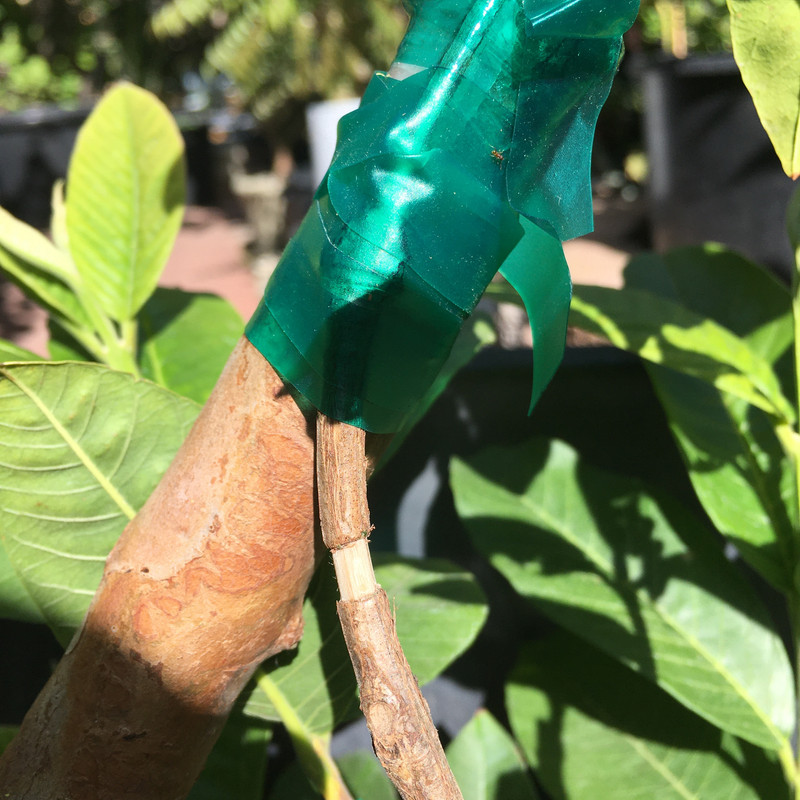
So I had to remove it later, lower than where I liked.”
Grafting Links
- Comparison of several grafting methods at a large scale
- Forum Thread: Are guavas difficult to graft?
- Forum Thread: Anyone has tips on grafting guava?
- Nursery grower explains their grafting procedure
Cultivars
These are just some I’m interested. Trying to list all guava varieties would be an impossible undertaking.
- Ruby Supreme[1,2]
- Sylvia[1,2] – Seems to actually be Carmine Guava that Kaz renamed
- Mexican Cream
- K-Rimes has one
Pruning
Pinching tips 2 or 3 times in July-August can increase the number of flowers.[1]
Maybe just pinch the tip after 3 sets of leaves form?
 Growing in Phoenix
Leave a comment